RAG Pipeline
Follow the data, decisions, feedback, and validation boundaries before writing the full system.
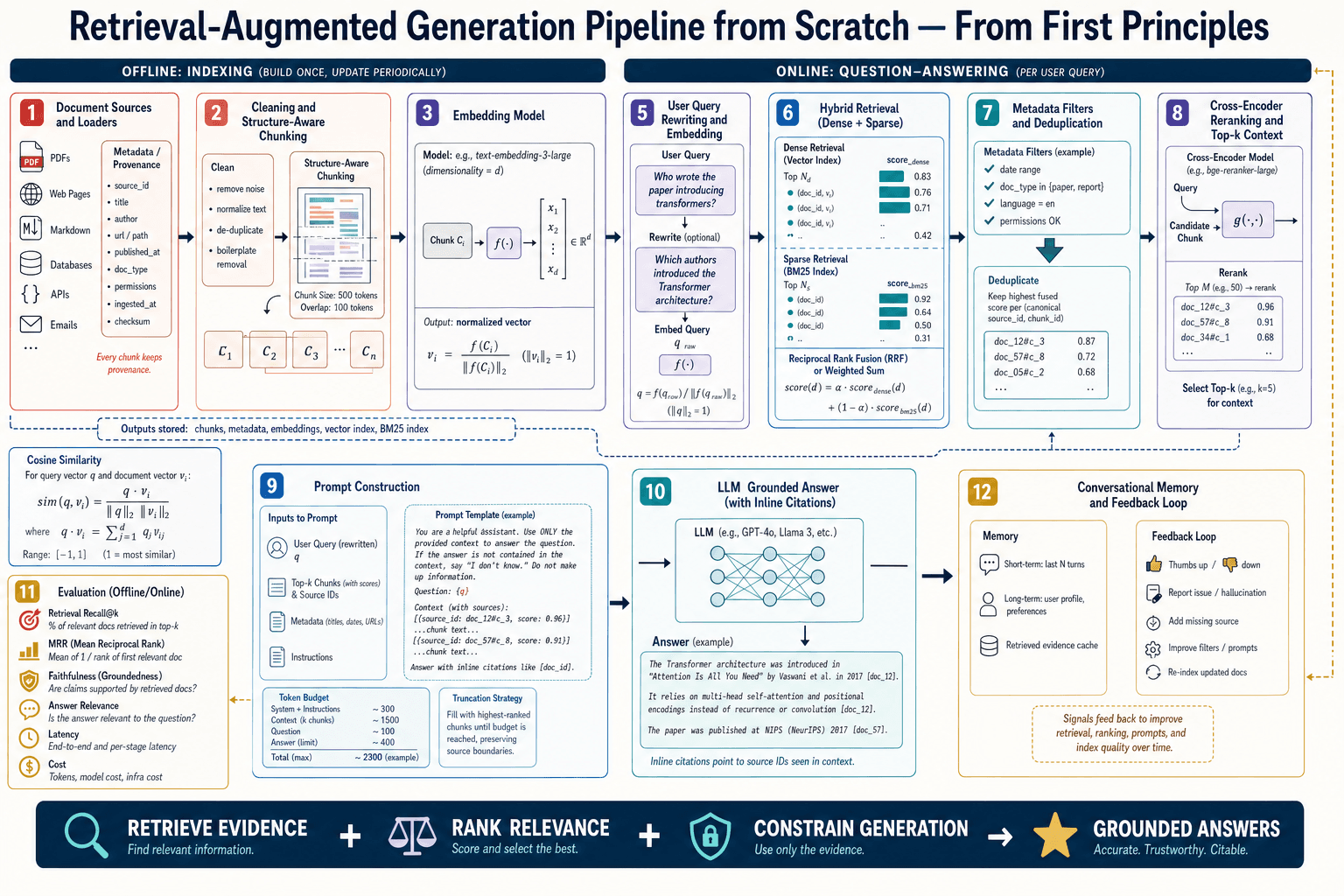
How to read this diagram
Read left to right for the forward path: raw information becomes a representation, passes through the project’s main computational ideas, and produces an output that can be measured. Then follow the feedback path back toward the trainable or decision-making components.
Vector search
Embeddings map items into a geometry where distance approximates semantic relatedness. Retrieval compares a query vector with document vectors, but useful systems also handle lexical matches, metadata filters, reranking, and evidence attribution.
Boundary check: document its accepted input, output shape, mutable state, failure modes, and the metric that proves this stage is correct before connecting it downstream.
Reranking
A reranker spends more computation on a small candidate set. Unlike a dual encoder that scores items independently, a cross-encoder can inspect query and document jointly and model fine-grained relevance.
Boundary check: document its accepted input, output shape, mutable state, failure modes, and the metric that proves this stage is correct before connecting it downstream.
Grounded generation
Grounded generation conditions an answer on retrieved evidence and requires claims to remain supported by that evidence. Retrieval quality, context packing, citation alignment, abstention, and faithfulness must be evaluated separately.
Boundary check: document its accepted input, output shape, mutable state, failure modes, and the metric that proves this stage is correct before connecting it downstream.
Architecture review checklist
- Every arrow has a documented shape, dtype, unit, or schema.
- Training and evaluation paths cannot leak information into each other.
- Randomness is seeded and captured in experiment metadata.
- Expensive stages expose timing, memory, throughput, and error metrics.
- Each feedback loop has a stop condition and a rollback strategy.
- Small reference implementations exist for numerical comparisons.