LoRA Fine-Tune a Chat Model
Follow the data, decisions, feedback, and validation boundaries before writing the full system.
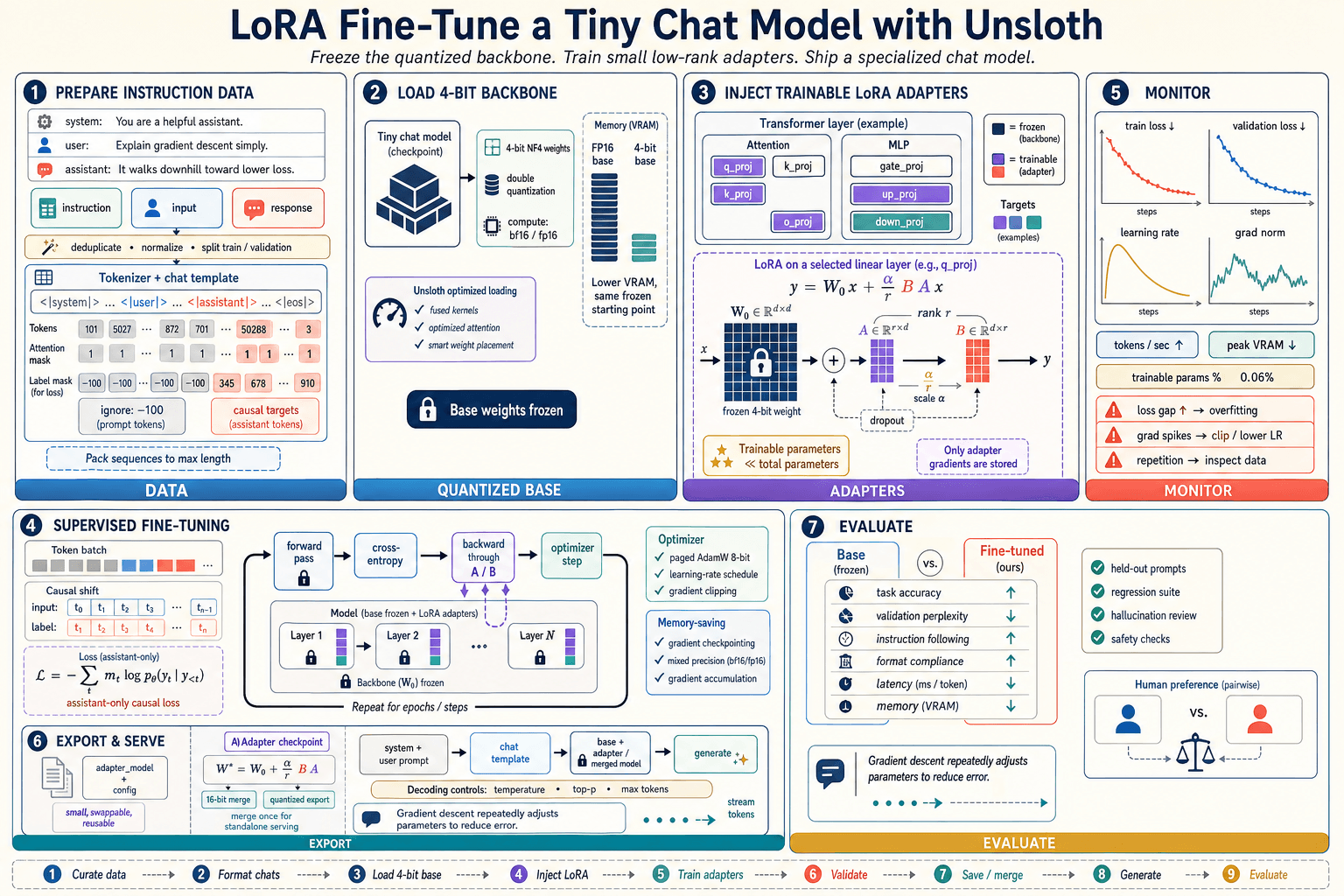
How to read this diagram
Read left to right for the forward path: raw information becomes a representation, passes through the project’s main computational ideas, and produces an output that can be measured. Then follow the feedback path back toward the trainable or decision-making components.
QLoRA
LoRA freezes a base weight matrix and learns a low-rank update BA. The rank limits trainable capacity and memory cost; placement, scaling, initialization, and target modules determine whether the adapter can express the required behavior.
Boundary check: document its accepted input, output shape, mutable state, failure modes, and the metric that proves this stage is correct before connecting it downstream.
SFT
SFT defines one of the project’s main information transformations. Understand its input representation, objective, numerical invariants, computational cost, and failure modes before relying on a library implementation.
Boundary check: document its accepted input, output shape, mutable state, failure modes, and the metric that proves this stage is correct before connecting it downstream.
Quantization
Quantization represents values with fewer bits using a scale and zero point or symmetric range. It reduces memory traffic and storage, but outliers, accumulation precision, calibration, and dequantization overhead control real quality and speed.
Boundary check: document its accepted input, output shape, mutable state, failure modes, and the metric that proves this stage is correct before connecting it downstream.
Architecture review checklist
- Every arrow has a documented shape, dtype, unit, or schema.
- Training and evaluation paths cannot leak information into each other.
- Randomness is seeded and captured in experiment metadata.
- Expensive stages expose timing, memory, throughput, and error metrics.
- Each feedback loop has a stop condition and a rollback strategy.
- Small reference implementations exist for numerical comparisons.